STAGE · Getting around
Overworld travel
Draft — Draft: checked against the game source, not yet read through end to endAvailable from the startPlot a walked route across the Iliac Bay, adjust its pace, and account for road, terrain and encounter settings.
This page is further along your path. Read ahead if you’re curious; you can return when you reach this stage.
Plan a route
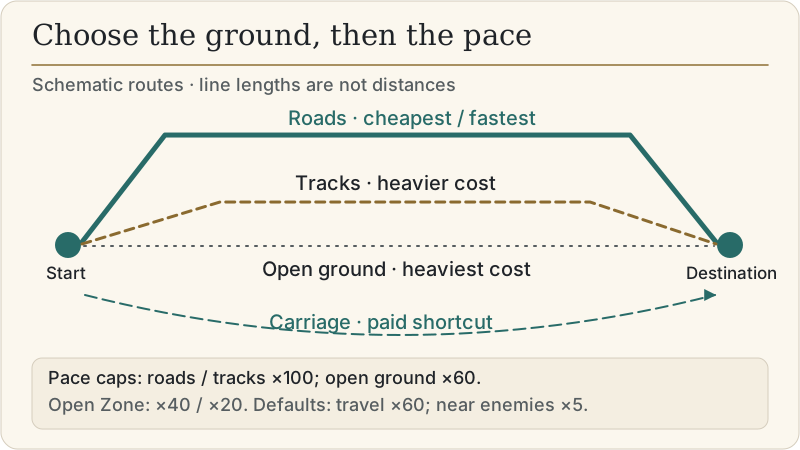
Choose your destination in the Overworld Travel View (the map and danger). The route planner weighs roads most cheaply, tracks more heavily and open ground most heavily. A longer road route can therefore be faster in the travel calculation than a short cross-country cut. Towns are crossed through their streets and gates rather than treated as open ground.
Walking costs no fare; the hired carriages page covers the paid shortcut. Your displayed pace is separate from the classic travel-time calculation: the pace controls how quickly the character moves through the active route, while the route and transport determine how much game time the trip represents. A horse changes your physical pace, not the route.
Set your pace
The pace dial offers ×5, ×10, ×20, ×30, ×40, ×60 and ×100. Outside the Open Zone, roads and tracks allow ×100 and open ground caps the active pace at ×60. In the Open Zone, the caps are ×40 on roads or tracks and ×20 on open ground. Leaving a road or track caps the running pace without erasing your chosen dial, which returns when you reach one. The near-enemy dial controls your slowest pace when a threat is close.
In Travel Options, Speed Penalty defaults to 20%, and Max Chance to Avoid Encounter defaults to 95%. Cautious travel's avoidance roll uses Luck and Stealth up to that cap. Reckless travel does not reduce the calculated trip time or provide Cautious travel's encounter avoidance. Review the pace and caution choices before setting out.
The wilderness between towns is also where spawned dungeons later appear, so a walked route can be an exploration trip rather than only a way to arrive.
Common mistakes
Taking the straight line because it looks shorter. The planner prices roads cheapest, tracks next and open ground most, so a longer road route can be faster. Cost: travel time on every trip.
Leaving the pace dial at its fastest through bad ground. Leaving a road or track caps the active pace (×60 outside the Open Zone) without changing your setting. Cost: a fast trip runs slower than you planned.
Using Cautious travel for every leg. Cautious is slower and only adds its encounter-avoidance roll; using it on safe roads spends session time. Cost: fewer activities per hour.
Next
Sources & checked facts
src/systems/travel/travelRoute.js:ROUTE_COST, route planningsrc/systems/travel/travelPace.js:PACE_STEPS,TRAVEL_PACE_DEFAULT, pace capssrc/systems/travel/travel.js:travelPixelMinutes,calculateTravelTimesrc/systems/travel/travelOptions.js:avoidEncounterChance,cautiousTravelMultipliersrc/systems/online/onlineLane.js: Travel Options online room settingssrc/systems/modSettings.js: Travel Options default caution penaltysrc/scenes/world.js: Open Zone pace capsResearch:
handbook/research/V1.md(walking and Overworld Travel View)